Why this resume works
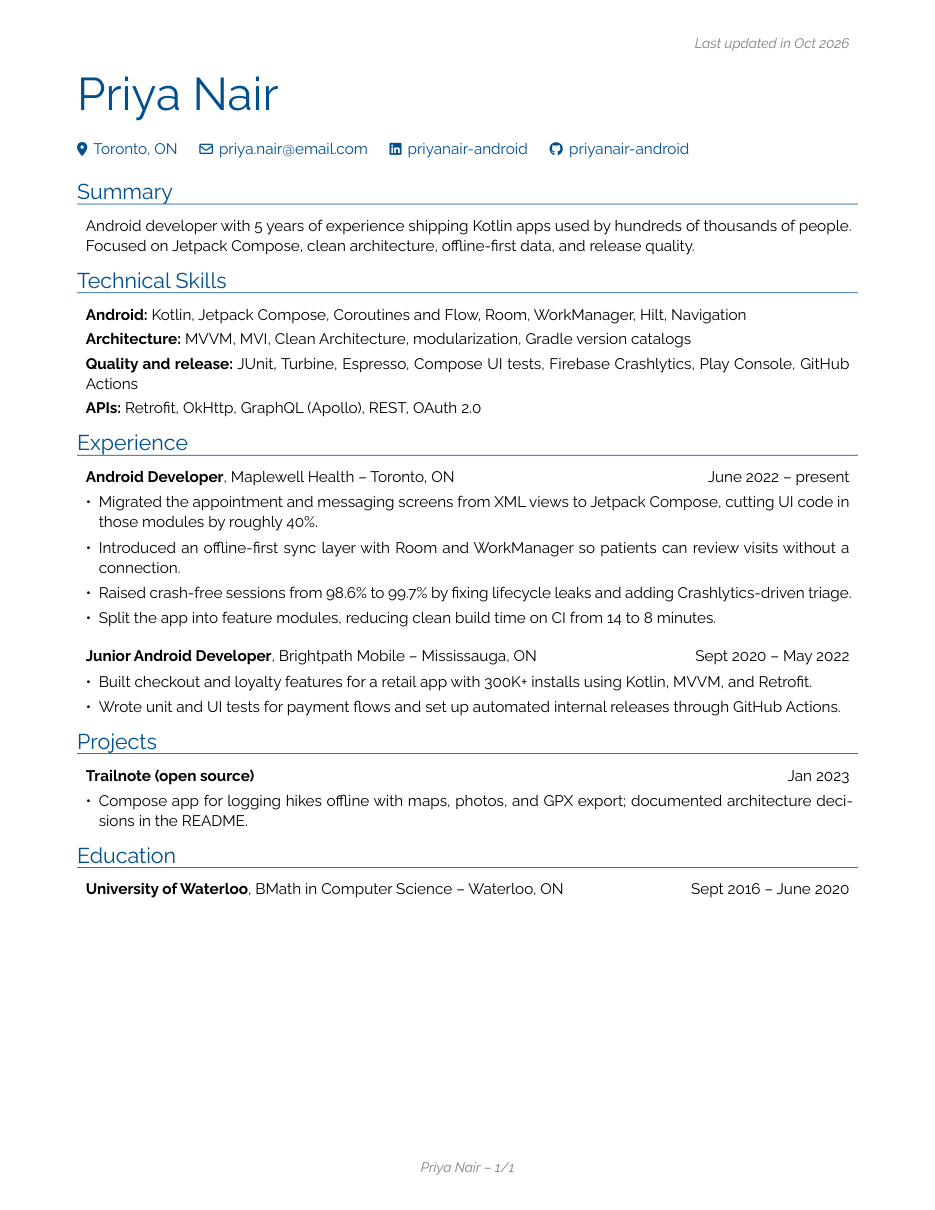
- Android is the headline, not a footnote. The summary says Kotlin, Compose, offline-first and release quality before anything else.
- The stack is organized the way Android teams think: Android APIs, architecture, quality and release, and networking.
- Metrics Android managers care about: crash-free sessions, build times, code reduction from a Compose migration.
- A reviewable side project with a clear README shows how the candidate structures an app end to end.
Skills Android postings ask for
| Group | Common in postings |
|---|---|
| Language and UI | Kotlin, Jetpack Compose, XML views (for legacy code), Material 3 |
| Async and data | Coroutines, Flow, Room, DataStore, WorkManager, Paging |
| Architecture | MVVM, MVI, Clean Architecture, modularization, Hilt/Dagger |
| Quality | JUnit, MockK, Turbine, Espresso, Compose UI tests, Crashlytics |
| Delivery | Gradle, CI (GitHub Actions, Bitrise), Play Console, staged rollouts |
Weak vs. strong Android bullets
Developed Android app features.
Migrated the appointment and messaging screens from XML to Jetpack Compose, cutting UI code in those modules by roughly 40%.
Fixed bugs and crashes.
Raised crash-free sessions from 98.6% to 99.7% by fixing lifecycle leaks and adding Crashlytics-driven triage.
Worked on build system.
Split the app into feature modules, reducing clean CI build time from 14 to 8 minutes.
Android resume summaries by level
The summary is where a recruiter checks your level in a few seconds. Match it to the role you are applying for:
Junior (0 to 2 years)
Junior Android developer with one published Kotlin app (Compose, Room, Hilt) and a 4-month co-op on a field-service app. Writes unit tests with JUnit and MockK and ships through GitHub Actions. Looking for a junior Android role in Toronto or remote in Canada.
Mid-level (3 to 5 years)
Android developer with 5 years building Kotlin apps for health and fintech products. Led a Compose migration across 3 feature modules and raised crash-free sessions to 99.7%. Strong in MVVM, Coroutines/Flow, offline-first sync and Play Console staged rollouts.
Senior or lead (6+ years)
Senior Android engineer with 9 years shipping consumer apps with 1M+ installs. Set the modularization and testing strategy for a team of 6, cutting CI build time by 40%. Experienced with Clean Architecture, MVI, Jetpack Compose and mentoring developers through code review.
No professional Android experience yet?
Hiring managers for junior roles look for proof that you can finish and ship an app. Put a Projects section above Experience and give your best app the same detail as a job:
- One line on what the app does and who it is for.
- The stack you chose and why (for example, Room for offline storage, WorkManager for sync).
- The hardest problem you solved, such as process death, pagination or background limits.
- A link to Google Play or the repository, with screenshots in the README.
Unrelated jobs still belong on the resume. Keep them to one or two bullets that show reliability, teamwork or customer contact.
What changes for senior and lead roles
- Scope over tasks: say how many screens, modules, developers or users your decisions affected.
- Technical direction: architecture choices, migration plans, testing strategy and how you got the team to adopt them.
- Delivery and quality: release cadence, rollout strategy, crash and ANR rates, app size and startup time.
- People: mentoring, code review standards, hiring loops and work with product, design and backend teams.
Making your Android project count
- Published on Google Play or with a signed APK and screenshots in the README.
- README explains the user problem, architecture diagram and key decisions.
- Tests exist and run in CI.
- Code is idiomatic Kotlin, uses current Jetpack libraries, and has no leaked API keys.
- Your resume bullet names the project's hardest technical problem.
Common mistakes
- Listing Java and Kotlin equally when you've only written Kotlin recently (or the reverse).
- No mention of testing or release work, which most mid-level postings expect.
- Play Store download numbers without saying what you contributed.
- A long list of every Jetpack library instead of the ones you actually know well.
Make your own Android developer resume
- Upload your current resume (PDF, DOCX or TXT) or paste the text into the free builder. No account needed.
- Choose the Tech template to get this exact look, or compare it with the other four.
- Review every line, then download your PDF. Downloads are free; your upload is deleted within 30 minutes.
With a free account, Tunquest finds up to 3 matching jobs a day in Canada and tailors your resume to each one. You review everything before you apply.
Frequently asked questions
Should I include Java on an Android resume?
Yes, if you have maintained Java code. Many companies still have legacy modules. List Kotlin first if that's your primary language.
How do I show Compose experience if my job still uses XML?
Use a side project or an internal migration you led, and describe it specifically.
Is the Tech template ATS-friendly?
Yes. Like all Tunquest templates, it's a single-column, text-based PDF generated with RenderCV.
Should an Android resume be one or two pages?
One page for junior roles. Two pages is normal with five or more years of Android work, as long as the first page shows your strongest recent experience.
Do I need a GitHub link on an Android resume?
It is not required, but for junior roles or career changes a public project with a clear README is often what gets you the interview.